Marcelo Baldin

The Paradox of Connection

We live in a paradoxical time.

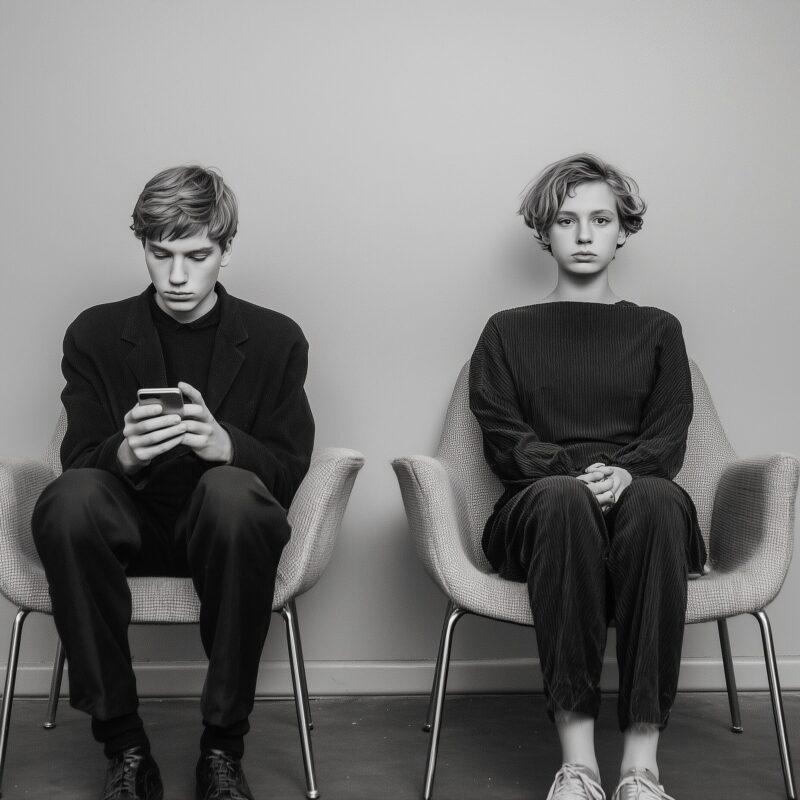
Social media has brought an enormous leap in connectivity between people. It eliminated intermediaries that once controlled information and democratized areas that used to be dominated by gatekeepers.
At the same time, it has brought intense side effects: it has amplified extremes, fueled aggression, and heightened anxiety. The neurological consequences are already felt on a global scale.

On the other hand, if we try to restrain the freedom that the internet has given us, we face another problem. We become even more vulnerable to control by governments and conglomerates, often without even realizing what is happening around us. This leaves us with two options:

- remain unaware and be run over by events, suffering the consequences of ignorance;

- or stay connected, but at the cost of neurosis.

Some may argue that a similar phenomenon occurred when television became accessible to the masses. But the intensity now is incomparable.

We can consider adopting methods suggested by authors such as Cal Newport, Jaron Lanier, and Neil Postman. Their proposals aim to reduce the impact of data overload without letting us be completely consumed by it. Yet, they often leave us somewhat detached, reliant on intermediaries.

Furthermore, almost none of these works address two crucial issues today: the Dead Internet Theory and Artificial Intelligence.

Until we find a solution, we continue to walk a tightrope—balanced between anguish and ignorance.

Cycles of Aesthetics

From time to time, society turns to the past to draw new impulses from it. This occurs because, at certain moments, the present no longer provides inspiration or meaningful prospects for the future. When the contemporary world appears stagnant or saturated, we return to what has already proven to hold vigor and significance.

Such movements arise periodically. The avant-garde often reaches a point of saturation: its creative energy begins to wear thin, and the dominant aesthetic starts to feel excessive or even destructive. While this does not necessarily lead to “social collapse,” there is a threshold of cultural rupture beyond which cycles of revisitation and renewal emerge.

These revivals are sometimes dismissed by the intellectual elite as mere “nostalgia.” Yet they are not simply nostalgic; rather, they represent efforts to rebuild upon foundations that once proved fruitful, now reshaped with new techniques and contexts. Such movements act as attempts to recalibrate the sensibility of an age and tend to spread most visibly through the arts. The Renaissance, Classicism, Romanticism, and others were each driven by reflection on the paths already taken and by the search for both aesthetic and existential adjustment.

Before the internet, these processes unfolded slowly, often taking decades to consolidate and disseminate. Today, however, we witness constant micro-revolutions, which appear to be converging toward a larger revision of the Zeitgeist. The past few decades have brought intense disruptions across multiple fields, reflected in a fragmented and chaotic aesthetic landscape. The pursuit of the sublime, once a guiding force in the arts, has to some extent been replaced by a culture of shock. The accelerated flow of information challenges human capacities for assimilation, generating a kind of stress that verges on incompatibility with our nature.

In response, a quieter movement has begun to take shape—one oriented toward simplicity, tranquility, and reconnection with what endures. It manifests in social and intellectual practices that resist both rampant consumerism and rigid ideological demands. Frequently labeled as conservatism, this impulse in fact acquires an avant-garde quality within the current context. Wearied by impositions, many are once again seeking the sublime—through a kind of futuristic revival that combines critiques of technology with a retreat from mass-produced pop culture.

From Amusing Ourselves to Death (Neil Postman, 1985) to Digital Minimalism (Cal Newport, 2019), calls for a more frugal and meaningful life have multiplied. Yet this impulse coexists with opposing forces that invest in the bizarre and the ephemeral. We thus live in tension between utopias and dystopias, both reflected in contemporary aesthetics. The key question is what kind of fruits each tendency will ultimately bear.

In the end, aesthetics divide into two broad orientations: those that seek only the fleeting instant and those that strive for the perennial. Their results, of course, are very different. Over the long term, some currents will endure as transformative, while others will be remembered merely as passing phases—like the Lisztomania of the nineteenth century.

Signal to Noise

The most valuable thing I’ve gained from stepping away from social media is this: We are constantly bombarded by noise. It clouds our thoughts, weakens our attention, and pushes us toward the average — the easiest opinions, the quickest reactions, the loudest takes. In that flux, clarity is rare, and poor decisions become routine.

Some contemporary composers, as well as cultural thinkers more broadly, suggest that noise can be embraced and even enjoyed. But that can only be true if there’s a cognitive pattern behind it — something that offers structure, something we can think with. Without that, there is no line of thought to follow. Noise, in this sense, is anything that resists contemplation.

Noise is the overflow of misinformation. It’s not just distortion — distraction, excess, and the dilution of meaning. It floods the mind with stimuli but offers no shape, direction, or pause for reflection.

Unless we train ourselves to listen through the noise, to filter and focus, we risk becoming passive receivers. We hear everything, yet absorb nothing. In a world saturated with sound and signal, the ability to truly listen may be the most essential discipline we can cultivate.

Silence

“Silence is the language of God. All else is poor translation.” – misattributed to Ludwig van Beethoven.

To get inspired, we must find a way to be quiet. Countless people retreat to reflect and recover. Lent is an ideal time to do it. Beethoven took long walks in nature to develop musical ideas. Claude Debussy – Found inspiration in the quiet contemplation of nature. Henry David Thoreau – Lived in solitude at Walden Pond to connect with deeper insights. Max Richter – Uses silence and minimalism as core elements in his music, often retreating into solitude for composition. Arvo Pärt – Known for his “tintinnabuli” style, he spent years in near silence before returning to composition. Björk – Frequently isolates herself in nature for inspiration, especially in Iceland’s quiet landscapes.

Lamentations 3:26 🤫

Pain

Pain reminds us that we have a limited and finite body, but it should also remind us that we are not our body; we only have a body. We are spirits, but if we think we are only a body, we will enter into continuous despair, suffocated by materialism, immediacy, and the anguish of avoiding discomfort. The awareness of who we are frees us from this finitude.

Once we are free of this conception of finitude, we can truly aspire to things greater than us. This can be reflected in the Zeitgeist; those who aim for trends are often stuck in their immediacy, whereas those who strive for superior aesthetics create timeless art, societal, or scientific pieces. This thought frees us from thinking only about our egos and allows us to live as a whole. Struggling to create is part of the process; it shouldn’t be avoided.